It was on the 25th October that Barry Reed found the 1st winter male Scaup at Amwell. I went back late morning to get some shots despite the weather being rather gloomy with really poor light. Luckily, eight days later the bird was still present so I went back to try and get some shots while the sun was out.
The Scaup was still present with some Tufted Ducks towards the southernern end on Tumbling Bay, but a bit further north than last time and therefore distance was an issue. However, by following the Lee Navigation footpath I was able to find a gap in the trees where I was able to get close enough for a few shots.
The bird is now further into its eventual male plumage, with a more extensive area of grey showing on the mantle, and the two pale marks either side of the bill that were evident last time have now disappeared. This photo illustrates the larger size of the Scaup compared to the Tufted Ducks.
Sunday, 4 November 2012
Friday, 2 November 2012
Poor Light Doesn't Stop Play - Part 2
The Grey Lag Goose flock were particularly active. Rather than just loafing around as usual, they were indulging in a communal bath-time which involved much splashing around whilst trying to get their plumage wet, followed by energetic preening and then much flapping of wings to get the whole lot dry again. Makes you feel worn out just watching them.
The Tufted Ducks are now starting to look a bit smarter with most of the males coming to the end of their eclipse moult. This male is almost back to his black and white garb, with just a few brown feathers remaining on the white flanks. Also, note the female showing off her wing-bar.
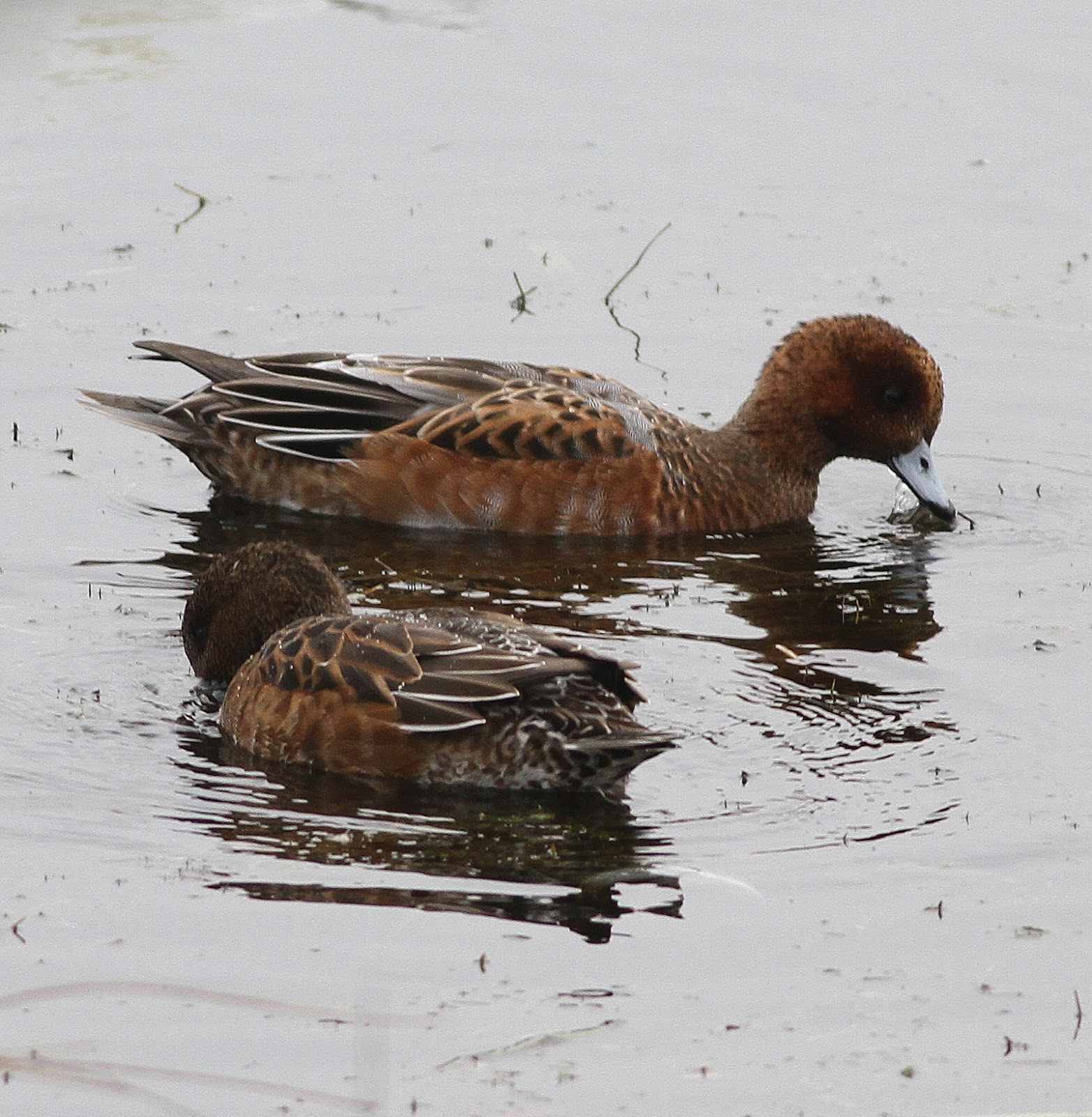
But the honours for Part 2 must go to the Wigeon which are now starting to appear. Wigeon are winter visitors to Amwell and are returning from their summer breeding grounds. They will build up to a few tens in number but never a large population as there is minimal suitable grazing on site. The bird at the back of the first photo and in the second photo is a male. Adults are already finishing off their eclipse plumage and sporting their silvery-grey attire so I suspect that this is a young bird, just moulting through into its male plumage for the first time.
The Tufted Ducks are now starting to look a bit smarter with most of the males coming to the end of their eclipse moult. This male is almost back to his black and white garb, with just a few brown feathers remaining on the white flanks. Also, note the female showing off her wing-bar.
But the honours for Part 2 must go to the Wigeon which are now starting to appear. Wigeon are winter visitors to Amwell and are returning from their summer breeding grounds. They will build up to a few tens in number but never a large population as there is minimal suitable grazing on site. The bird at the back of the first photo and in the second photo is a male. Adults are already finishing off their eclipse plumage and sporting their silvery-grey attire so I suspect that this is a young bird, just moulting through into its male plumage for the first time.
Monday, 29 October 2012
Poor Light Doesn't Stop Play - Part 1
What a dark gloomy morning. I therefore decided to go and do the shopping in the morning and see what the afternoon would bring. Just five minutes after I arrived at Tescos I received a phone call from Tony Pickford to say that a male Mandarin was showing well in front of the White Hide at Amwell. Not surprisingly, by the time I got home and made my way down to Amwell, the Mandarin had long departed. The light was still poor and to make matters worse, there was a cold northerly wind blowing across the viewpoint, and so I decided to set up camp in the relative cosiness of the White Hide. From a photography point of view the White Hide is at its best on dull days like this, because otherwise the sun is in your eyes. Also, with the water levels in the lake rising for the winter, there were plenty of water birds performing at close quarters.
Amwell has large numbers of Coot during the winter months, but even at this time of year they are starting to display and can often be seen swimming around all puffed up to make themselves look larger and more threatening. They also lower their heads down to the water in front of them to look aggressive.
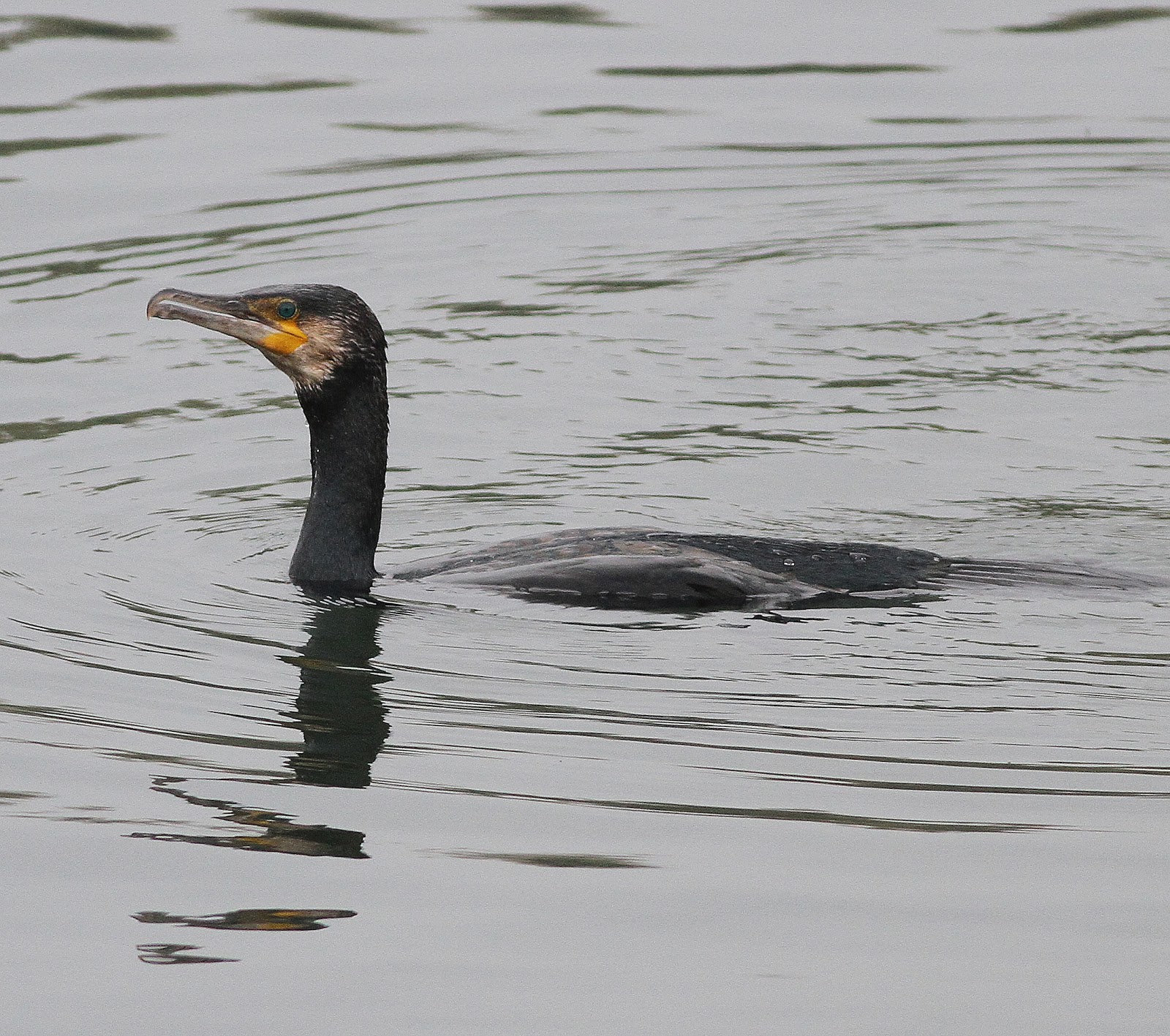
Like most other inland waters, there is also a healthy population of Cormorants. They breed on the island in front of the viewpoint and stay around in good numbers during the winter, generally loafing on the islands and tern rafts when they are not feeding. Luckily one was diving for fish right in front of the hide. Look how low they are in the water. No wonder they can slide under the water with the greatest of ease.
Herons also breed on the islands and are a regular feature at Amwell but never in large numbers during the winter months. Although they can be seen feeding along the water margins, particularly at the edges of the reed beds, they also spend hours just sitting around, digesting their food.
But to end Part 1 I have chosen one of the most under-rated birds in the UK, the Gadwall. I am sure that these dull-coloured ducks (male grey, female brown) are frequently overlooked and dismissed as female Mallard but, if you ever have the opportunity, take a close look at the subtle colours and vermiculation of the males. The female is indeed very similar to a female Mallard but the speculum on the wing is white instead of blue.
Amwell has large numbers of Coot during the winter months, but even at this time of year they are starting to display and can often be seen swimming around all puffed up to make themselves look larger and more threatening. They also lower their heads down to the water in front of them to look aggressive.
Like most other inland waters, there is also a healthy population of Cormorants. They breed on the island in front of the viewpoint and stay around in good numbers during the winter, generally loafing on the islands and tern rafts when they are not feeding. Luckily one was diving for fish right in front of the hide. Look how low they are in the water. No wonder they can slide under the water with the greatest of ease.
Herons also breed on the islands and are a regular feature at Amwell but never in large numbers during the winter months. Although they can be seen feeding along the water margins, particularly at the edges of the reed beds, they also spend hours just sitting around, digesting their food.
But to end Part 1 I have chosen one of the most under-rated birds in the UK, the Gadwall. I am sure that these dull-coloured ducks (male grey, female brown) are frequently overlooked and dismissed as female Mallard but, if you ever have the opportunity, take a close look at the subtle colours and vermiculation of the males. The female is indeed very similar to a female Mallard but the speculum on the wing is white instead of blue.
Thursday, 25 October 2012
Scaup at Amwell
I was Amwell this morning when a phone call came through that Barry Reed had found a Scaup at Tumbling Bay, so half a dozen of us set off in hot pursuit. It is quite a trek to Hardmead Lock where it had been found but with heads down and a brisk walk it didn't take that long.
Fortunately, when we got there it wasn't too far away, although the light conditions were dreadful. It was relatively easy to pick out but was diving almost continuously, only staying on the surface for a few minutes, and staying under the surface for a long time.
This was not the most colourful of individuals. It was obviously a Scaup due to its very rounded head, larger size than Tufted Duck and the grey starting to show through on the mantle. The grey on the mantle points to this being a male bird and therefore, at this time of year when adults should be more advanced in their eclipse plumage, a first winter bird. The first photo gives a good size comparison with Tufted Duck.
Fortunately, when we got there it wasn't too far away, although the light conditions were dreadful. It was relatively easy to pick out but was diving almost continuously, only staying on the surface for a few minutes, and staying under the surface for a long time.
This was not the most colourful of individuals. It was obviously a Scaup due to its very rounded head, larger size than Tufted Duck and the grey starting to show through on the mantle. The grey on the mantle points to this being a male bird and therefore, at this time of year when adults should be more advanced in their eclipse plumage, a first winter bird. The first photo gives a good size comparison with Tufted Duck.
Sunday, 21 October 2012
Amwell Assortment
It was a pleasant sunny morning so I thought I would have a wander up
the lane at Amwell. The Lee Navigation towpath was very quiet so I
popped into the James Hide in case the Kingfisher decided to oblige. No
such luck there, but a Reed Bunting was carefully manoeuvring towards the
feeders and allowed a couple of shots before he jumped on to the feeder
itself (I absolutely refuse to photograph birds on feeders). Even at this time of year the black head is already starting to show through indicating that this is a male.
Next stop is the Bittern Pool with the compulsory scan along the reed margins hoping for a Bittern to be showing albeit for perhaps just a few seconds. Once again no luck but a Grey Heron flapped lazily across the pool in search of a new feeding ground. To the left of the pool a female Chaffinch was sitting on the outside of a sallow, making the most of the warm autumn sun.
Next stop was the bridge over the old River Lea. Under the old Bailey Bridge left over from the gravel working days there used to be a lump of concrete on the side of the bank where, with the aid of a telescope you could often see Otter droppings called spraints. Unfortunately, during heavy rain a couple of years ago the river flooded and the concrete was washed away. It has been replaced by a log but doesn't seem to attract Otters in the same way.
The only sign of wildlife here was a rather old male Common Darter which was enjoying the warmth of the wooden handrail. This late in the year the only two dragonflies still flying are the Migrant Hawker and the Common Darter. These will continue to fly until the first hard frosts and, in recent years, Common Darters have been recorded egg-laying as late as November.
Just as I was about to leave a I could hear the "weeooo" call of a Siskin and a couple of birds appeared over the trees and landed right overhead in clear view. A little high up but a great way to end the day.
Wednesday, 17 October 2012
Tewinbury Revisited
My last visit to Tewinbury was very rewarding with plenty of action resulting in good shots of Siskin, Kingfisher, Green Sandpiper and Grey Wagtail, so I thought I would try my luck again. The water levels were still low with lots and lots of oozy mud but, unlike last time, the site was fairly deserted. This was particularly frustrating as the light was very good and going to waste. I say there was nothing, but of course there are always a few Moorhens creeping along the edge of the reeds so they became the subject of the day.
The adults are always a pleasure to photograph with their gaudy red and yellow bill setting off an otherwise sombre charcoal and brown body plumage.
The young birds are a totally different kettle of fish being a much paler grey and lacking the bright bill. They are so dull at times they I suspect that they are sometimes mistaken for the elusive Water Rail as they creep about just inside the reeds.
Still no sign of any Kingfishers or Grey Wagtails but then the shrill triple call of a Green Sandpiper, which circled the area in front of the hide and settled on the other side of the mud. A little later it was joined by a second bird. After a long wait one of the birds did work its way round to this side of the mud and allowed a couple of reasonable shots to be taken.
The adults are always a pleasure to photograph with their gaudy red and yellow bill setting off an otherwise sombre charcoal and brown body plumage.
The young birds are a totally different kettle of fish being a much paler grey and lacking the bright bill. They are so dull at times they I suspect that they are sometimes mistaken for the elusive Water Rail as they creep about just inside the reeds.
Still no sign of any Kingfishers or Grey Wagtails but then the shrill triple call of a Green Sandpiper, which circled the area in front of the hide and settled on the other side of the mud. A little later it was joined by a second bird. After a long wait one of the birds did work its way round to this side of the mud and allowed a couple of reasonable shots to be taken.
Saturday, 13 October 2012
Last Hobby of the Year
An early Autumn visit to Rye Meads proved to be a relatively quiet day. The water level in front of the Draper Hide was high, covering all the wide expanses of mud, so no feeding waders and just a few Mallard, Shoveler, Teal, Pochard and Tufted Duck. However, the scene from the hide was still full of vibrant colours due to the abundance of the yellow Buttonweed growing all over the islands. Amazingly, when I checked on the status of Buttonweed in the Flora of Hertfordshire, published just three years ago, I found that it was not in there........because it is a new species for Hertfordshire!! It is most likely that it has been brought in on birds feet.
A scan of the islands did in fact reveal the presence of some Common Snipe, all asleep unless they were disturbed by a passing duck.
Suddenly, a raptor appeared over the trees at the back of the reed bed. Clearly a sharp-winged falcon and at it came closer, scything its way through the air, it was possible to see the tell-tale white throat and collar of a Hobby. Hobbys are summer visitors to the UK and this fairly late individual was taking the opportunity to feed up on the still fairly numerous Migrant Hawker and Common Darter dragonflies present at Rye Meads at the current time. Probably the last one we will see this year.
A scan of the islands did in fact reveal the presence of some Common Snipe, all asleep unless they were disturbed by a passing duck.
Suddenly, a raptor appeared over the trees at the back of the reed bed. Clearly a sharp-winged falcon and at it came closer, scything its way through the air, it was possible to see the tell-tale white throat and collar of a Hobby. Hobbys are summer visitors to the UK and this fairly late individual was taking the opportunity to feed up on the still fairly numerous Migrant Hawker and Common Darter dragonflies present at Rye Meads at the current time. Probably the last one we will see this year.
Subscribe to:
Posts (Atom)